
Semax
Synthetic heptapeptide (ACTH fragment analogue)
Also known as Met-Glu-His-Phe-Pro-Gly-Pro, ACTH(4-7)-Pro-Gly-Pro
A synthetic analogue of the ACTH(4-10) fragment, developed in Russia and studied in models of cognition, stroke and neuroprotection.
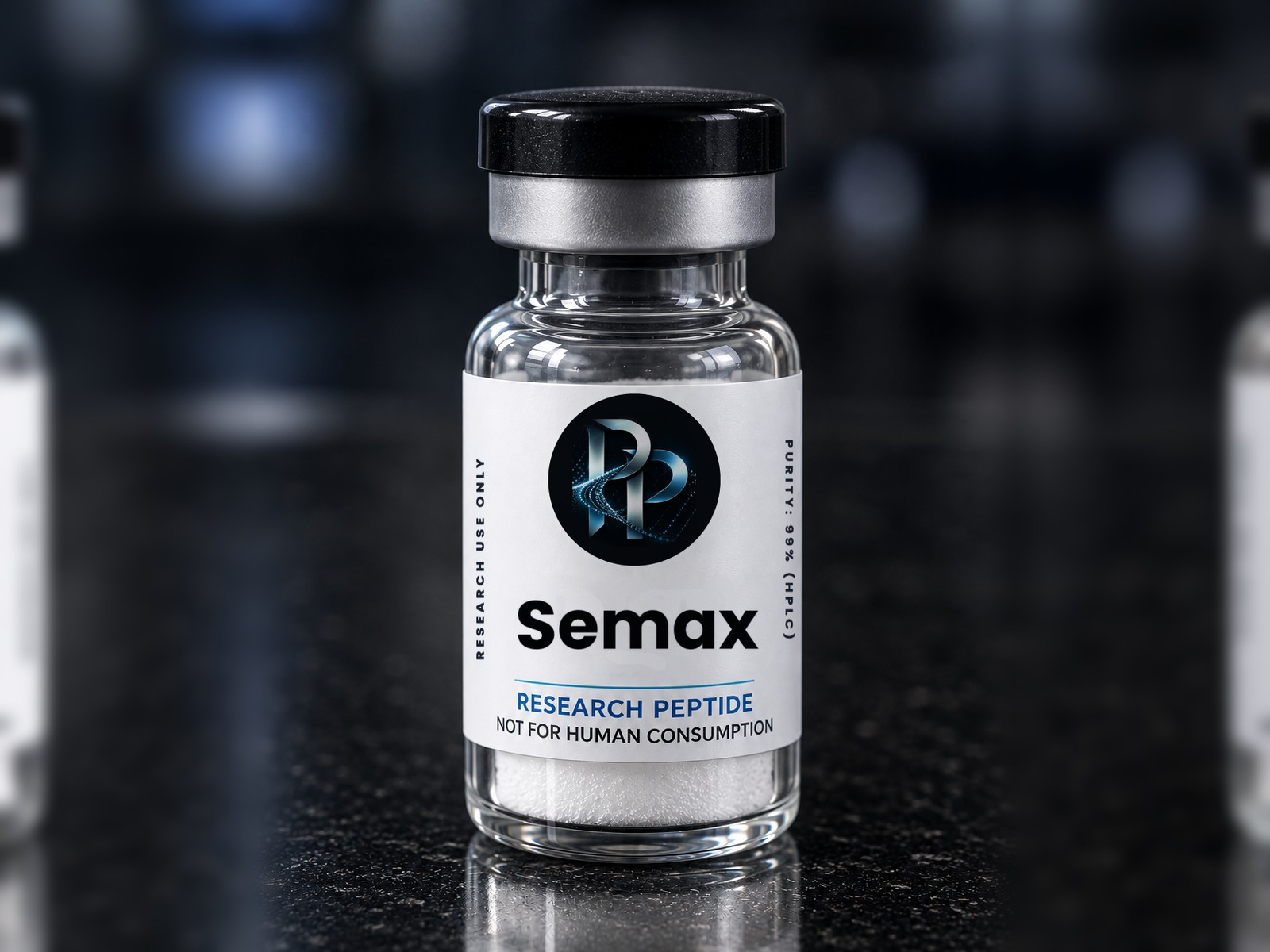
Technical information
Values are shown with their status. “Verified” means the value has been checked against a primary database such as PubChem.
- Classification
- Synthetic heptapeptide (ACTH fragment analogue)
- CAS number
- 80714-61-0 Pending
- Molecular formula
- C37H51N9O10S Pending
- Molecular weight
- 813.9 g/mol Pending
- Sequence / structure
- Met-Glu-His-Phe-Pro-Gly-Pro (MEHFPGP) Pending
Some values are still being checked and should be treated as provisional until marked verified.
How this compound is tested
LC-MS identity and HPLC purity; oxidised-methionine impurities should be reported where present.
Research background
Semax was developed at the Institute of Molecular Genetics (Moscow) and is registered in Russia for several neurological indications. It lacks the corticotropic (hormonal) activity of ACTH. The international literature consists mainly of rodent and cell studies, with Russian clinical reports.
Mechanisms investigated in published research
These are the mechanisms examined in the cited literature. Describing them is not a claim that the compound produces any effect in humans.
- Reported upregulation of BDNF and TrkB expression in rodent hippocampus.
- Proposed modulation of neurotransmitter systems and anti-inflammatory gene expression after ischaemia.
Summary of evidence
Laboratory and animal findings are kept separate from human clinical evidence.
Preclinical findings
Rodent studies in learning, attention and cerebral ischaemia models reported neuroprotective and pro-cognitive effects.
Human clinical evidence
Russian clinical studies supported domestic registration; no international, peer-reviewed phase 3 trials exist. No approval in the UK, EU or US.
Limitations and open questions
- As for Selank: limited international replication and study quality concerns.
- Methionine residue is susceptible to oxidation; analytical reports should address this.
Scientific references
Publications cited on this page. Links open the publisher or PubMed record.
No references have been published for this entry yet.
Research use only
Semax is described here for laboratory research. It is not approved for human or veterinary use unless a regulator has said otherwise, and nothing on this page is medical advice or guidance on administration. A disclaimer does not by itself make any activity lawful. Full disclaimer.
Contact options
Talk to the Positive Peptides team about Semax
Order enquiries, documentation requests and technical questions about this compound — we answer directly, usually within two working days.
Related compounds
 Neuroscience Research99% purity
DSIP
Naturally occurring nonapeptide (synthetic form)
A nonapeptide first isolated from rabbit cerebral venous blood in the 1970s on the basis of sleep-inducing activity. Its physiological role remains unresolved.
 Neuroscience Research99% purity
Pinealon
Synthetic tripeptide
A tripeptide from the same Russian 'bioregulator' research programme as epithalon, studied in neuronal cell culture and rodent models of brain ageing and hypoxia.
 Neuroscience Research99% purity
Selank
Synthetic heptapeptide (tuftsin analogue)
A synthetic analogue of the immunomodulatory tetrapeptide tuftsin, extended with a Pro-Gly-Pro tail for stability. Developed in Russia and studied in anxiety and cognition models.