
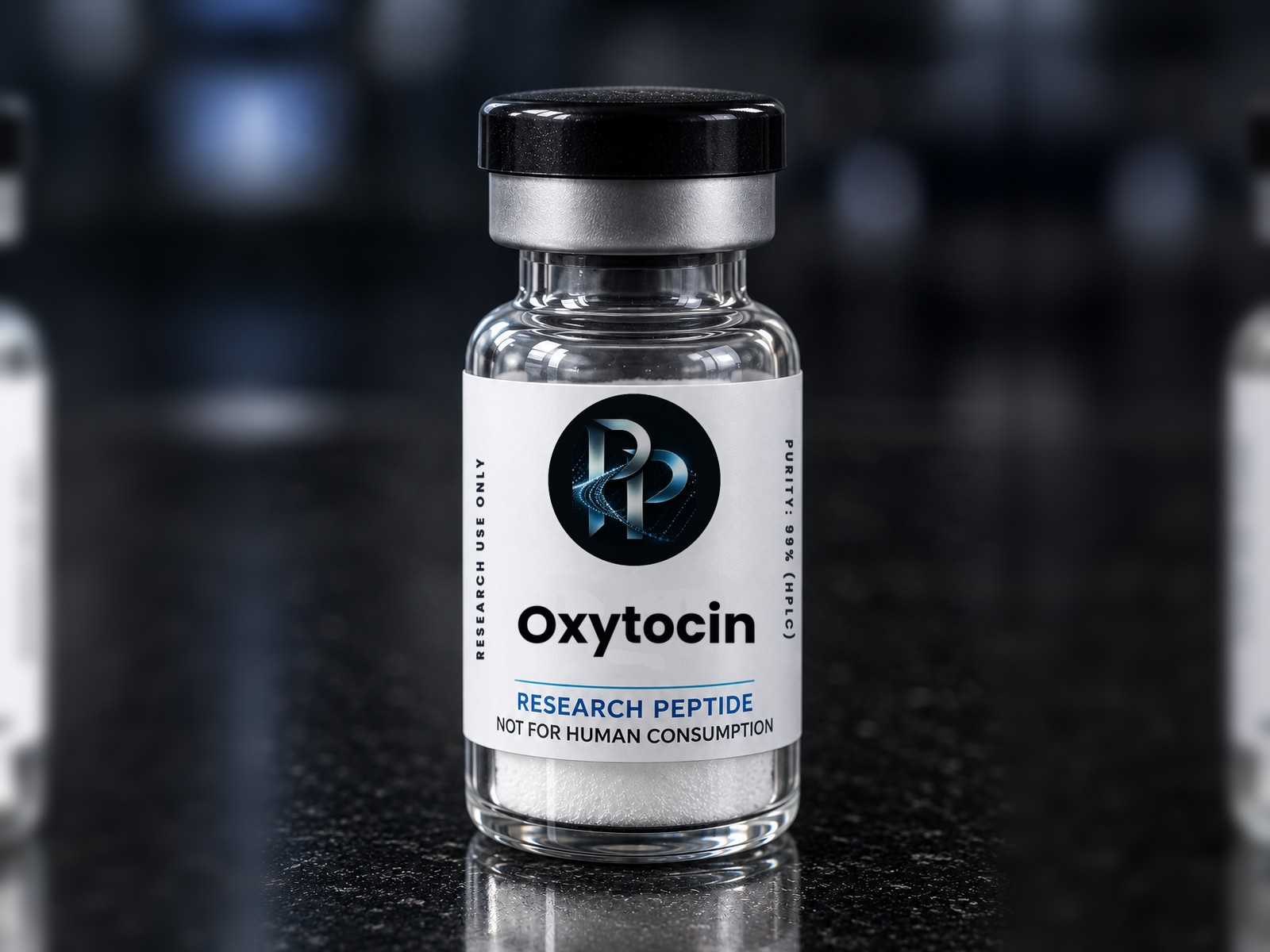
Oxytocin
Cyclic nonapeptide hormone (synthetic form)
Also known as OXT, Pitocin / Syntocinon (proprietary names of licensed products)
A hypothalamic nonapeptide hormone and a licensed medicine in obstetrics. Research interest extends to social behaviour, stress physiology and receptor pharmacology.
Technical information
Values are shown with their status. “Verified” means the value has been checked against a primary database such as PubChem.
- Classification
- Cyclic nonapeptide hormone (synthetic form)
- CAS number
- 50-56-6 Pending
- Molecular formula
- C43H66N12O12S2 Pending
- Molecular weight
- 1007.2 g/mol Pending
- Sequence / structure
- Cys-Tyr-Ile-Gln-Asn-Cys-Pro-Leu-Gly-NH2 (disulfide Cys1–Cys6) Pending
Some values are still being checked and should be treated as provisional until marked verified.
How this compound is tested
HPLC purity and LC-MS identity; disulfide-bridged species should be distinguished from reduced or dimeric forms.
Research background
Oxytocin was the first peptide hormone to be sequenced and synthesised (du Vigneaud, 1953). Its clinical roles in labour and lactation are well established, and synthetic oxytocin is a licensed medicine worldwide. Research-grade oxytocin is used in receptor pharmacology and behavioural neuroscience, where intranasal oxytocin has been the subject of a large but inconsistent literature.
Mechanisms investigated in published research
These are the mechanisms examined in the cited literature. Describing them is not a claim that the compound produces any effect in humans.
- Oxytocin receptor (OXTR) agonism, a Gq-coupled GPCR, in uterine smooth muscle, mammary myoepithelium and brain.
- Cross-reactivity with vasopressin receptors at higher concentrations.
Summary of evidence
Laboratory and animal findings are kept separate from human clinical evidence.
Preclinical findings
Extensive rodent and primate literature on social behaviour, maternal behaviour and stress responses.
Human clinical evidence
Licensed obstetric uses are supported by decades of clinical evidence. Behavioural studies of intranasal oxytocin in humans have produced inconsistent, often non-replicated findings. Research-grade material is not the licensed medicine.
Limitations and open questions
- Replication problems in the behavioural literature.
- Peptide is prone to disulfide scrambling and deamidation; analytical reports should address related substances.
Scientific references
Publications cited on this page. Links open the publisher or PubMed record.
No references have been published for this entry yet.
Research use only
Oxytocin is described here for laboratory research. It is not approved for human or veterinary use unless a regulator has said otherwise, and nothing on this page is medical advice or guidance on administration. A disclaimer does not by itself make any activity lawful. Full disclaimer.
Contact options
Talk to the Positive Peptides team about Oxytocin
Order enquiries, documentation requests and technical questions about this compound — we answer directly, usually within two working days.
Related compounds
 Neuroscience Research99% purity
DSIP
Naturally occurring nonapeptide (synthetic form)
A nonapeptide first isolated from rabbit cerebral venous blood in the 1970s on the basis of sleep-inducing activity. Its physiological role remains unresolved.
 Neuroscience Research99% purity
Kisspeptin-10
C-terminal decapeptide of kisspeptin (KISS1 gene product)
The minimal active fragment of kisspeptin, the KISS1R (GPR54) ligand that is a master regulator of GnRH release. Widely used in reproductive-neuroendocrinology research.