
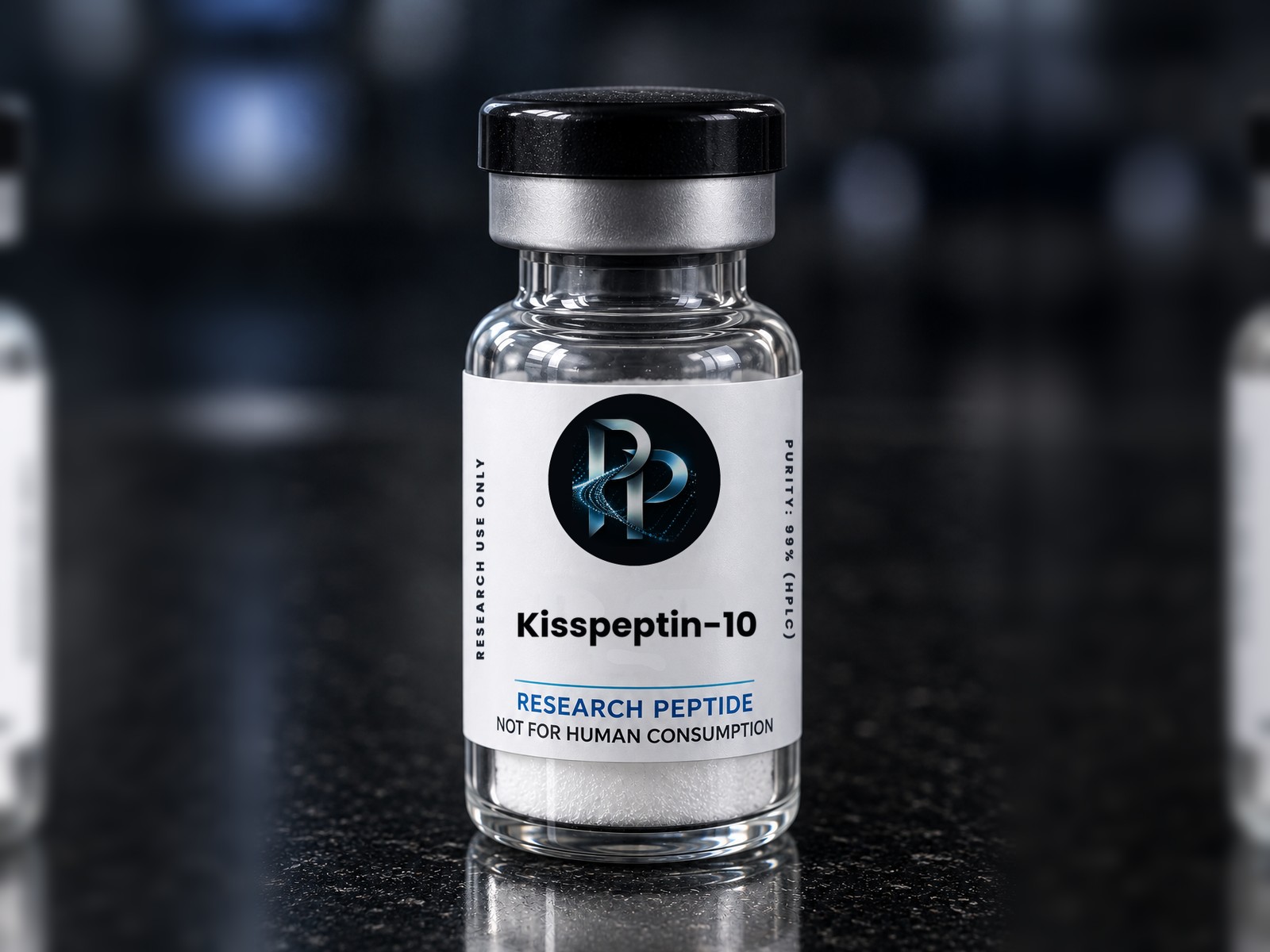
Kisspeptin-10
C-terminal decapeptide of kisspeptin (KISS1 gene product)
Also known as Metastin(45-54), KP-10
The minimal active fragment of kisspeptin, the KISS1R (GPR54) ligand that is a master regulator of GnRH release. Widely used in reproductive-neuroendocrinology research.
Technical information
Values are shown with their status. “Verified” means the value has been checked against a primary database such as PubChem.
- Classification
- C-terminal decapeptide of kisspeptin (KISS1 gene product)
- CAS number
- 374675-21-5 Pending
- Molecular formula
- C63H83N17O14 Pending
- Molecular weight
- 1302.4 g/mol Pending
- Sequence / structure
- Tyr-Asn-Trp-Asn-Ser-Phe-Gly-Leu-Arg-Phe-NH2 (YNWNSFGLRF-NH2) Pending
Some values are still being checked and should be treated as provisional until marked verified.
How this compound is tested
LC-MS identity for the amidated decapeptide and HPLC purity.
Research background
Kisspeptins were identified as metastasis-suppressor gene products ("metastin") before their central role in puberty and reproduction was discovered in 2003, when loss-of-function KISS1R mutations were linked to hypogonadotropic hypogonadism. Kisspeptin-10 retains full receptor activity and is a standard research tool. Longer forms (kisspeptin-54) have been studied in humans.
Mechanisms investigated in published research
These are the mechanisms examined in the cited literature. Describing them is not a claim that the compound produces any effect in humans.
- KISS1R (GPR54) agonism on hypothalamic GnRH neurons, stimulating GnRH and downstream LH/FSH release.
- Studied in models of puberty onset, fertility and reproductive endocrinology.
Summary of evidence
Laboratory and animal findings are kept separate from human clinical evidence.
Preclinical findings
Extensive rodent, sheep and primate studies characterise kisspeptin control of the hypothalamic–pituitary–gonadal axis.
Human clinical evidence
1 citedHuman physiological studies, mainly with kisspeptin-54 (e.g., Dhillo et al., 2005), show stimulation of LH and FSH in healthy volunteers. Kisspeptin analogues have been studied in IVF settings. No approved medicine.
Limitations and open questions
- Receptor desensitisation with continuous exposure.
- Most human data use kisspeptin-54 rather than the decapeptide.
Scientific references
Publications cited on this page. Links open the publisher or PubMed record.
[1]Dhillo WS, Chaudhri OB, Patterson M, et al.. Kisspeptin-54 stimulates the hypothalamic-pituitary gonadal axis in human males. Journal of Clinical Endocrinology & Metabolism (2005).
Human clinical Citation pendingHuman physiology study of kisspeptin-54 (not KP-10).
Research use only
Kisspeptin-10 is described here for laboratory research. It is not approved for human or veterinary use unless a regulator has said otherwise, and nothing on this page is medical advice or guidance on administration. A disclaimer does not by itself make any activity lawful. Full disclaimer.
Contact options
Talk to the Positive Peptides team about Kisspeptin-10
Order enquiries, documentation requests and technical questions about this compound — we answer directly, usually within two working days.
Related compounds
 Neuroscience Research99% purity
Oxytocin
Cyclic nonapeptide hormone (synthetic form)
A hypothalamic nonapeptide hormone and a licensed medicine in obstetrics. Research interest extends to social behaviour, stress physiology and receptor pharmacology.
 Melanocortin Research99% purity
PT-141 (Bremelanotide)
Cyclic heptapeptide melanocortin receptor agonist (MC4R-preferring)
A metabolite/analogue of Melanotan II that differs by a C-terminal carboxylic acid. Licensed in the United States as a medicine for a specific indication; used in research as an MC4R-preferring reference agonist.