
NAD⁺
Pyridine nucleotide coenzyme
Also known as Nicotinamide adenine dinucleotide (oxidised), β-NAD, Coenzyme I
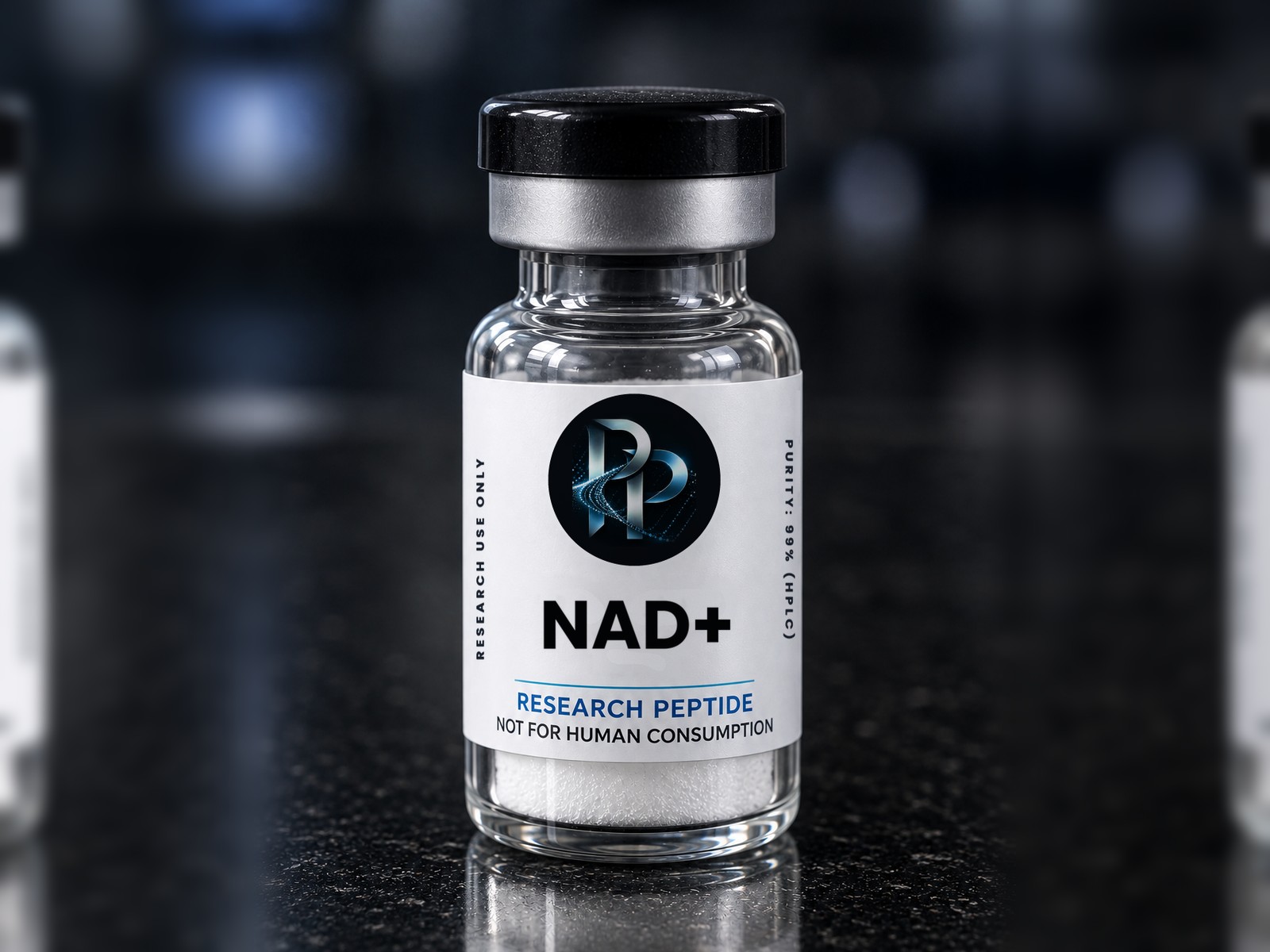
A ubiquitous coenzyme central to redox metabolism and a substrate for sirtuins, PARPs and CD38. A major focus of ageing and metabolism research because cellular NAD⁺ levels decline with age in many tissues.
Technical information
Values are shown with their status. “Verified” means the value has been checked against a primary database such as PubChem.
- Classification
- Pyridine nucleotide coenzyme
- CAS number
- 53-84-9 Pending
- Molecular formula
- C21H27N7O14P2 Pending
- Molecular weight
- 663.4 g/mol Pending
- Sequence / structure
- Not applicable (dinucleotide) Pending
Some values are still being checked and should be treated as provisional until marked verified.
How this compound is tested
Small-molecule characterisation: HPLC-UV purity with reference standard, LC-MS identity, and often water content (Karl Fischer) because NAD⁺ salts are hygroscopic. Enzymatic assays can quantify NAD⁺ specifically.
Research background
NAD⁺ cycles between oxidised (NAD⁺) and reduced (NADH) forms in hundreds of metabolic reactions. Beyond redox chemistry, it is consumed as a substrate by signalling enzymes including sirtuins, poly(ADP-ribose) polymerases and the glycohydrolase CD38. Research since the 2000s has characterised age-related declines in tissue NAD⁺ and the effects of precursors such as nicotinamide riboside and nicotinamide mononucleotide in animal models (Covarrubias et al., 2021).
Mechanisms investigated in published research
These are the mechanisms examined in the cited literature. Describing them is not a claim that the compound produces any effect in humans.
- Redox cofactor in glycolysis, the TCA cycle and oxidative phosphorylation.
- Substrate for sirtuin deacylases, linking NAD⁺ availability to chromatin and metabolic regulation.
- Substrate for PARPs in DNA-damage signalling and for CD38/CD157 in calcium signalling.
Summary of evidence
Laboratory and animal findings are kept separate from human clinical evidence.
Preclinical findings
Rodent studies of NAD⁺ precursor supplementation report effects on mitochondrial function, metabolic phenotypes and age-related physiology; the literature is large and methodologically varied.
Human clinical evidence
Human trials have mainly studied oral precursors (NR, NMN) and report increases in blood NAD⁺ metabolites with generally modest or inconsistent functional outcomes. Intravenous NAD⁺ has been used clinically in some settings without a robust controlled-trial evidence base. None of this constitutes evidence for research-grade NAD⁺ in any application.
Limitations and open questions
- Tissue-level NAD⁺ in humans is difficult to measure; blood metabolite changes do not necessarily reflect tissue changes.
- Precursor trials are short and heterogeneous in design.
- NAD⁺ is chemically labile in solution; stability data should accompany any analytical report.
Scientific references
Publications cited on this page. Links open the publisher or PubMed record.
[1]Covarrubias AJ, Perrone R, Grozio A, Verdin E. NAD+ metabolism and its roles in cellular processes during ageing. Nature Reviews Molecular Cell Biology (2021).
Review Citation pending
Research use only
NAD⁺ is described here for laboratory research. It is not approved for human or veterinary use unless a regulator has said otherwise, and nothing on this page is medical advice or guidance on administration. A disclaimer does not by itself make any activity lawful. Full disclaimer.
Contact options
Talk to the Positive Peptides team about NAD⁺
Order enquiries, documentation requests and technical questions about this compound — we answer directly, usually within two working days.
Related compounds
 Cellular & Ageing Research99% purity
Epithalon
Synthetic tetrapeptide
A synthetic tetrapeptide developed in Russia, studied in cell culture for effects on telomerase expression and in animal models of ageing. The evidence base is largely from a single research institute.
 Cellular & Ageing Research99% purity
Glutathione (reduced)
Endogenous tripeptide antioxidant
The most abundant intracellular non-protein thiol, central to redox buffering, detoxification and protein thiol regulation. A standard reagent in oxidative-stress research.
 Cellular & Ageing Research99% purity
MOTS-c
Mitochondrial-derived 16-amino-acid peptide
A peptide encoded within the mitochondrial 12S rRNA gene, described in 2015 as a regulator of metabolic homeostasis in mice.