
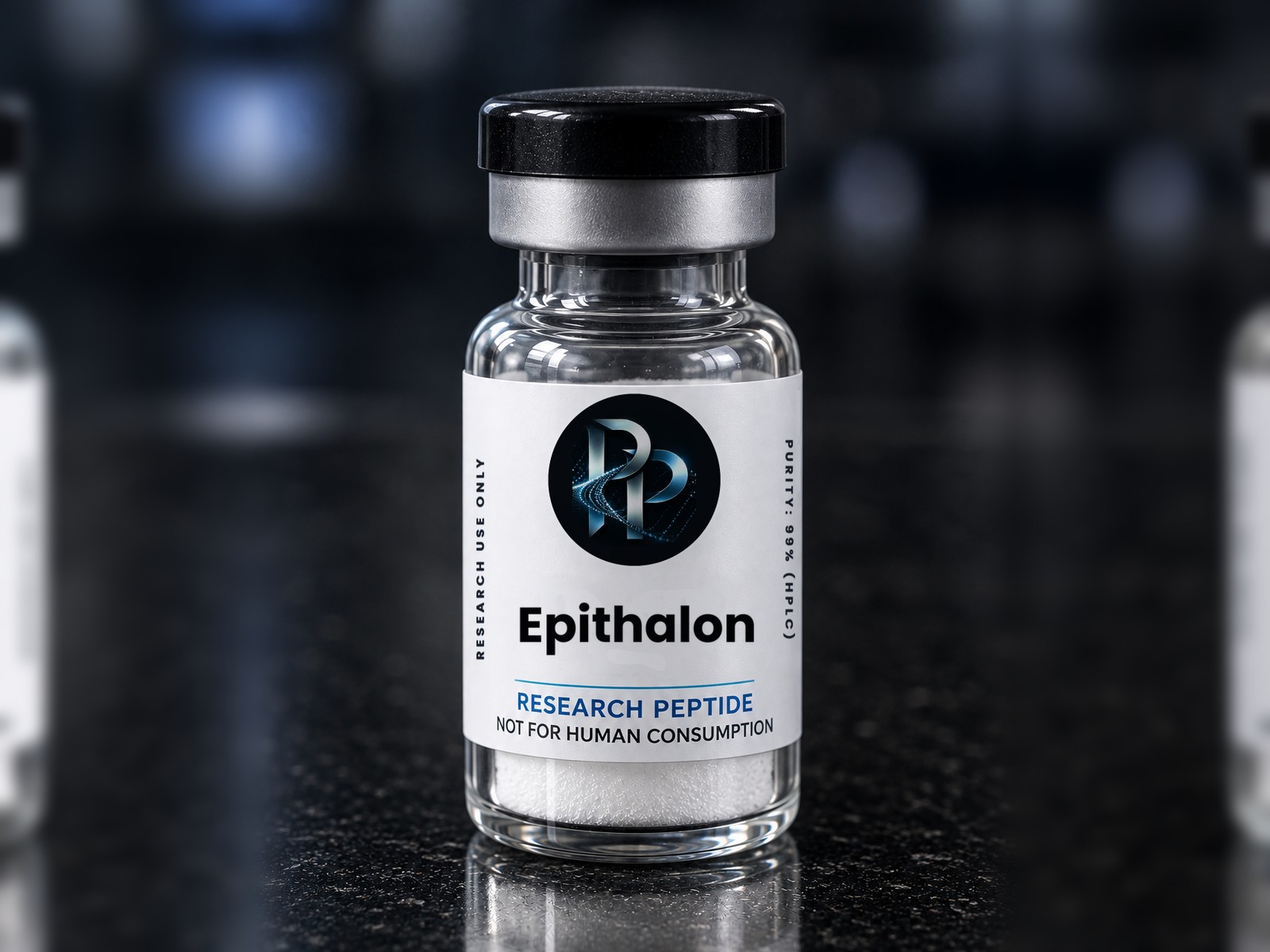
Epithalon
Synthetic tetrapeptide
Also known as Epitalon, Epithalone, Ala-Glu-Asp-Gly
A synthetic tetrapeptide developed in Russia, studied in cell culture for effects on telomerase expression and in animal models of ageing. The evidence base is largely from a single research institute.
Technical information
Values are shown with their status. “Verified” means the value has been checked against a primary database such as PubChem.
- Classification
- Synthetic tetrapeptide
- CAS number
- 307297-39-8 Pending
- Molecular formula
- C14H22N4O9 Pending
- Molecular weight
- 390.3 g/mol Pending
- Sequence / structure
- Ala-Glu-Asp-Gly (AEDG) Pending
Some values are still being checked and should be treated as provisional until marked verified.
How this compound is tested
A tetrapeptide is straightforward to characterise by LC-MS and HPLC. Researchers should be aware that the acidic residues make the peptide hygroscopic; water content affects net peptide content.
Research background
Epithalon was designed by Khavinson and colleagues at the St Petersburg Institute of Bioregulation and Gerontology as a synthetic analogue of the pineal extract "epithalamin". The published literature consists mainly of Russian-language and institute-authored studies in cell lines and rodents, with limited independent replication.
Mechanisms investigated in published research
These are the mechanisms examined in the cited literature. Describing them is not a claim that the compound produces any effect in humans.
- Reported activation of telomerase in human somatic cell cultures.
- Proposed effects on melatonin secretion and pineal function in animal models.
- Reported changes in gene expression in cultured cells.
Summary of evidence
Laboratory and animal findings are kept separate from human clinical evidence.
Preclinical findings
Rodent lifespan and tumour-incidence studies and cell-culture telomerase studies from the originating institute. Independent, well-controlled replications are scarce.
Human clinical evidence
No peer-reviewed randomised controlled trials in a Western journal were identified. Institute-reported human studies lack the design features needed to draw conclusions.
Limitations and open questions
- Single-source literature with limited independent replication.
- Many primary sources are not indexed in major databases or are not in English.
- Telomerase findings in vitro have not been linked to any validated outcome.
Scientific references
Publications cited on this page. Links open the publisher or PubMed record.
No references have been published for this entry yet.
Research use only
Epithalon is described here for laboratory research. It is not approved for human or veterinary use unless a regulator has said otherwise, and nothing on this page is medical advice or guidance on administration. A disclaimer does not by itself make any activity lawful. Full disclaimer.
Contact options
Talk to the Positive Peptides team about Epithalon
Order enquiries, documentation requests and technical questions about this compound — we answer directly, usually within two working days.
Related compounds
 Cellular & Ageing Research99% purity
MOTS-c
Mitochondrial-derived 16-amino-acid peptide
A peptide encoded within the mitochondrial 12S rRNA gene, described in 2015 as a regulator of metabolic homeostasis in mice.
 Cellular & Ageing Research99% purity
NAD⁺
Pyridine nucleotide coenzyme
A ubiquitous coenzyme central to redox metabolism and a substrate for sirtuins, PARPs and CD38. A major focus of ageing and metabolism research because cellular NAD⁺ levels decline with age in many tissues.
 Neuroscience Research99% purity
Pinealon
Synthetic tripeptide
A tripeptide from the same Russian 'bioregulator' research programme as epithalon, studied in neuronal cell culture and rodent models of brain ageing and hypoxia.