
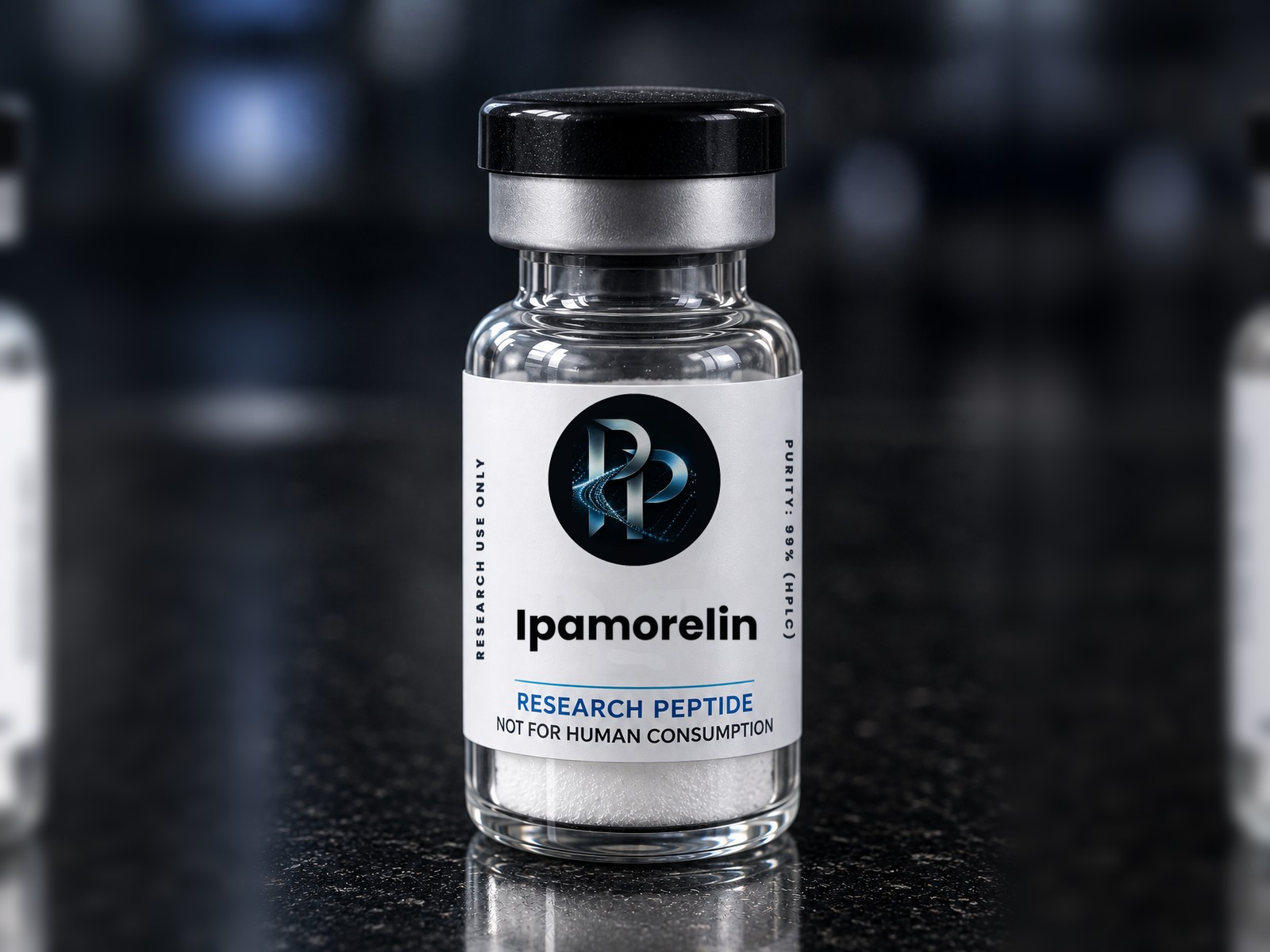
Ipamorelin
Pentapeptide growth-hormone secretagogue (ghrelin receptor agonist)
Also known as NNC 26-0161
A synthetic pentapeptide agonist of the growth-hormone secretagogue receptor (GHS-R1a). Described in its original publication as selective for GH release with little effect on ACTH or cortisol.
Technical information
Values are shown with their status. “Verified” means the value has been checked against a primary database such as PubChem.
- Classification
- Pentapeptide growth-hormone secretagogue (ghrelin receptor agonist)
- CAS number
- 170851-70-4 Pending
- Molecular formula
- C38H49N9O5 Pending
- Molecular weight
- 711.9 g/mol Pending
- Sequence / structure
- Aib-His-D-2-Nal-D-Phe-Lys-NH2 Pending
Some values are still being checked and should be treated as provisional until marked verified.
How this compound is tested
A small modified pentapeptide containing non-natural residues (Aib, D-2-Nal, D-Phe): identity by LC-MS and purity by HPLC; chiral integrity is not routinely assessed on standard COAs.
Research background
Ipamorelin was developed by Novo Nordisk in the 1990s as part of a programme to identify growth-hormone secretagogues with improved selectivity. The original characterisation (Raun et al., 1998) compared it with GHRP-6 and reported GH release in rat pituitary cells and in vivo, without the prolactin, ACTH and cortisol release seen with earlier secretagogues. Clinical development for post-operative ileus was later discontinued.
Mechanisms investigated in published research
These are the mechanisms examined in the cited literature. Describing them is not a claim that the compound produces any effect in humans.
- GHS-R1a (ghrelin receptor) agonism stimulating GH release.
- Reported selectivity over ACTH/cortisol and prolactin release compared with GHRP-6 and GHRP-2.
Summary of evidence
Laboratory and animal findings are kept separate from human clinical evidence.
Preclinical findings
1 cited- Rat pituitary cell assays and in-vivo rat and swine studies characterised GH release and selectivity (Raun et al., 1998).
- Rodent studies examined bone and gastrointestinal motility endpoints.
Human clinical evidence
Early clinical studies were conducted during pharmaceutical development, including for post-operative ileus, but the programme was discontinued. No approved medicinal product exists.
Limitations and open questions
- Published human data are limited and development was halted.
- Selectivity claims derive mainly from the original pharmaceutical characterisation.
- Prohibited in sport under the WADA list.
Scientific references
Publications cited on this page. Links open the publisher or PubMed record.
[1]Raun K, Hansen BS, Johansen NL, et al.. Ipamorelin, the first selective growth hormone secretagogue. European Journal of Endocrinology (1998).
Preclinical Citation pendingOriginal pharmacological characterisation (in-vitro and animal).
Research use only
Ipamorelin is described here for laboratory research. It is not approved for human or veterinary use unless a regulator has said otherwise, and nothing on this page is medical advice or guidance on administration. A disclaimer does not by itself make any activity lawful. Full disclaimer.
Contact options
Talk to the Positive Peptides team about Ipamorelin
Order enquiries, documentation requests and technical questions about this compound — we answer directly, usually within two working days.
Related compounds
 Growth Hormone Axis Research99% purity
CJC-1295 (without DAC)
Tetrasubstituted GHRH(1-29) analogue
A 29-amino-acid GHRH analogue with four substitutions that improve stability. The 'no DAC' form lacks the drug-affinity-complex maleimide linker present in the long-acting CJC-1295 studied clinically.
 Growth Hormone Axis Research99% purity
GHRP-2
Synthetic hexapeptide growth-hormone secretagogue
A second-generation GHRP with higher potency than GHRP-6. Approved in Japan as a diagnostic agent (pralmorelin) for growth-hormone deficiency.
 Growth Hormone Axis Research99% purity
GHRP-6
Synthetic hexapeptide growth-hormone secretagogue
One of the first synthetic growth-hormone-releasing peptides, developed from met-enkephalin analogues. Its discovery led to the identification of the ghrelin receptor.
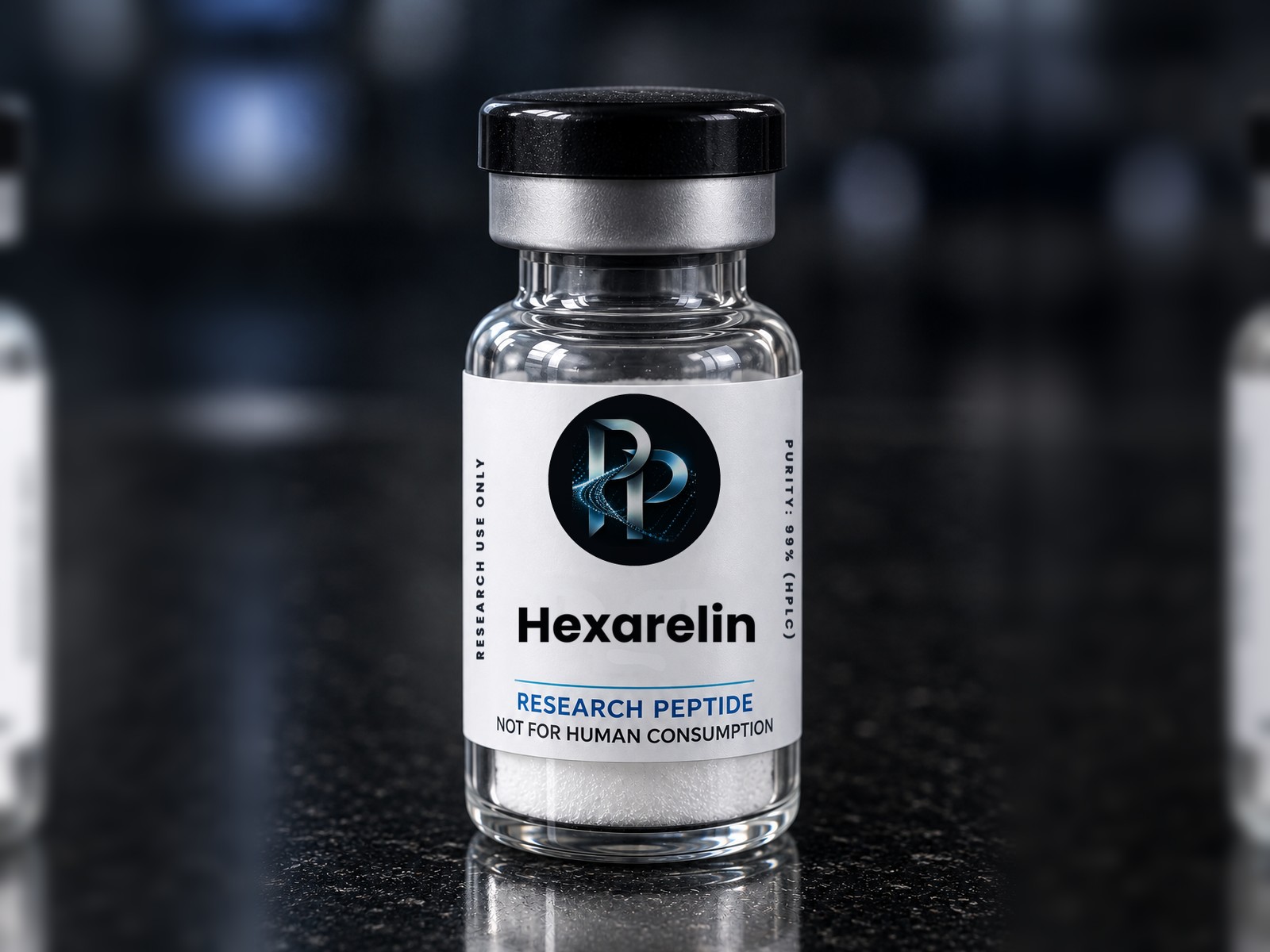 Growth Hormone Axis Research99% purity
Hexarelin
Synthetic hexapeptide growth-hormone secretagogue
A GHRP-6 analogue with a 2-methyl-tryptophan substitution, studied for GH release and, separately, for cardiac effects attributed to CD36 binding.