
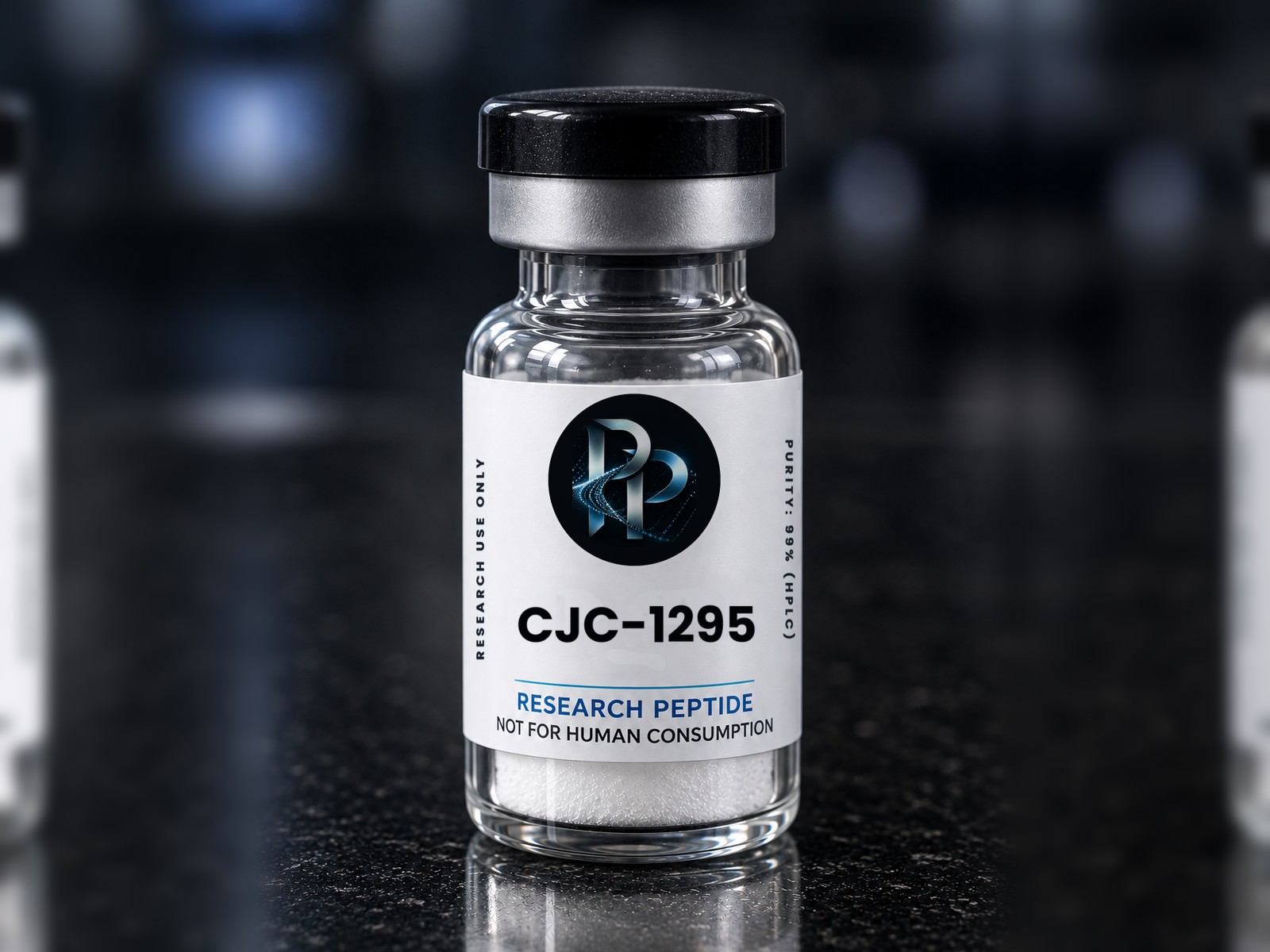
CJC-1295 (without DAC)
Tetrasubstituted GHRH(1-29) analogue
Also known as Modified GRF (1-29), Mod GRF 1-29, tetrasubstituted GRF(1-29)
A 29-amino-acid GHRH analogue with four substitutions that improve stability. The 'no DAC' form lacks the drug-affinity-complex maleimide linker present in the long-acting CJC-1295 studied clinically.
Technical information
Values are shown with their status. “Verified” means the value has been checked against a primary database such as PubChem.
- Classification
- Tetrasubstituted GHRH(1-29) analogue
- CAS number
- 863288-34-0 Pending
- Molecular formula
- C152H252N44O42 Pending
- Molecular weight
- 3367.9 g/mol Pending
- Sequence / structure
- GHRH(1-29)-NH2 with D-Ala2, Gln8, Ala15 and Leu27 substitutions Pending
Some values are still being checked and should be treated as provisional until marked verified.
How this compound is tested
LC-MS mass should match the tetrasubstituted 29-residue amidated sequence; an observed mass around 3.65 kDa would indicate the DAC-modified species instead. HPLC purity should be read with attention to deamidation products.
Research background
The sequence commonly supplied as "CJC-1295 without DAC" or "Modified GRF (1-29)" is the tetrasubstituted GHRH(1-29) core of CJC-1295. The clinically studied compound CJC-1295 (with DAC) adds a lysine-linked maleimidopropionic acid group that covalently binds serum albumin, giving a multi-day half-life. The two forms are frequently confused in supplier catalogues; researchers should confirm from mass-spectrometry data which species they are working with.
Mechanisms investigated in published research
These are the mechanisms examined in the cited literature. Describing them is not a claim that the compound produces any effect in humans.
- GHRH receptor agonism producing GH release from pituitary somatotrophs.
- Substitutions at positions 2, 8, 15 and 27 reduce enzymatic cleavage and oxidation relative to native GHRH.
Summary of evidence
Laboratory and animal findings are kept separate from human clinical evidence.
Preclinical findings
Receptor pharmacology and GH-release characterisation in animal models during development of the CJC-1295 series.
Human clinical evidence
1 citedHuman data exist for CJC-1295 with DAC (Teichman et al., 2006), where healthy adults showed dose-dependent increases in GH and IGF-1 in a phase 1 study. No equivalent controlled human data were identified for the no-DAC form. Neither form is an approved medicine.
Limitations and open questions
- Confusion between DAC and no-DAC species is common; mass data (~3368 Da versus ~3648 Da) distinguish them.
- No human safety or efficacy data for the no-DAC form.
- Prohibited in sport under the WADA list.
Scientific references
Publications cited on this page. Links open the publisher or PubMed record.
[1]Teichman SL, Neale A, Lawrence B, Gagnon C, Castaigne JP, Frohman LA. Prolonged stimulation of growth hormone (GH) and insulin-like growth factor I secretion by CJC-1295, a long-acting analog of GH-releasing hormone, in healthy adults. Journal of Clinical Endocrinology & Metabolism (2006).
Human clinical Citation pendingPhase 1 in healthy adults; concerns CJC-1295 WITH DAC.
Research use only
CJC-1295 (without DAC) is described here for laboratory research. It is not approved for human or veterinary use unless a regulator has said otherwise, and nothing on this page is medical advice or guidance on administration. A disclaimer does not by itself make any activity lawful. Full disclaimer.
Contact options
Talk to the Positive Peptides team about CJC-1295 (without DAC)
Order enquiries, documentation requests and technical questions about this compound — we answer directly, usually within two working days.
Related compounds
 Growth Hormone Axis Research99% purity
Ipamorelin
Pentapeptide growth-hormone secretagogue (ghrelin receptor agonist)
A synthetic pentapeptide agonist of the growth-hormone secretagogue receptor (GHS-R1a). Described in its original publication as selective for GH release with little effect on ACTH or cortisol.
 Growth Hormone Axis Research99% purity
Sermorelin
Synthetic GHRH(1-29) amide
The N-terminal 29-amino-acid fragment of human GHRH, which retains full receptor activity. Formerly marketed as a diagnostic and therapeutic agent; now used in research as a reference GHRH agonist.
 Growth Hormone Axis Research99% purity
Tesamorelin
Synthetic GHRH(1-44) analogue (trans-3-hexenoyl modified)
A stabilised analogue of growth-hormone-releasing hormone (GHRH). Licensed in some jurisdictions for a specific indication; used in research to study the hypothalamic–pituitary GH axis.