
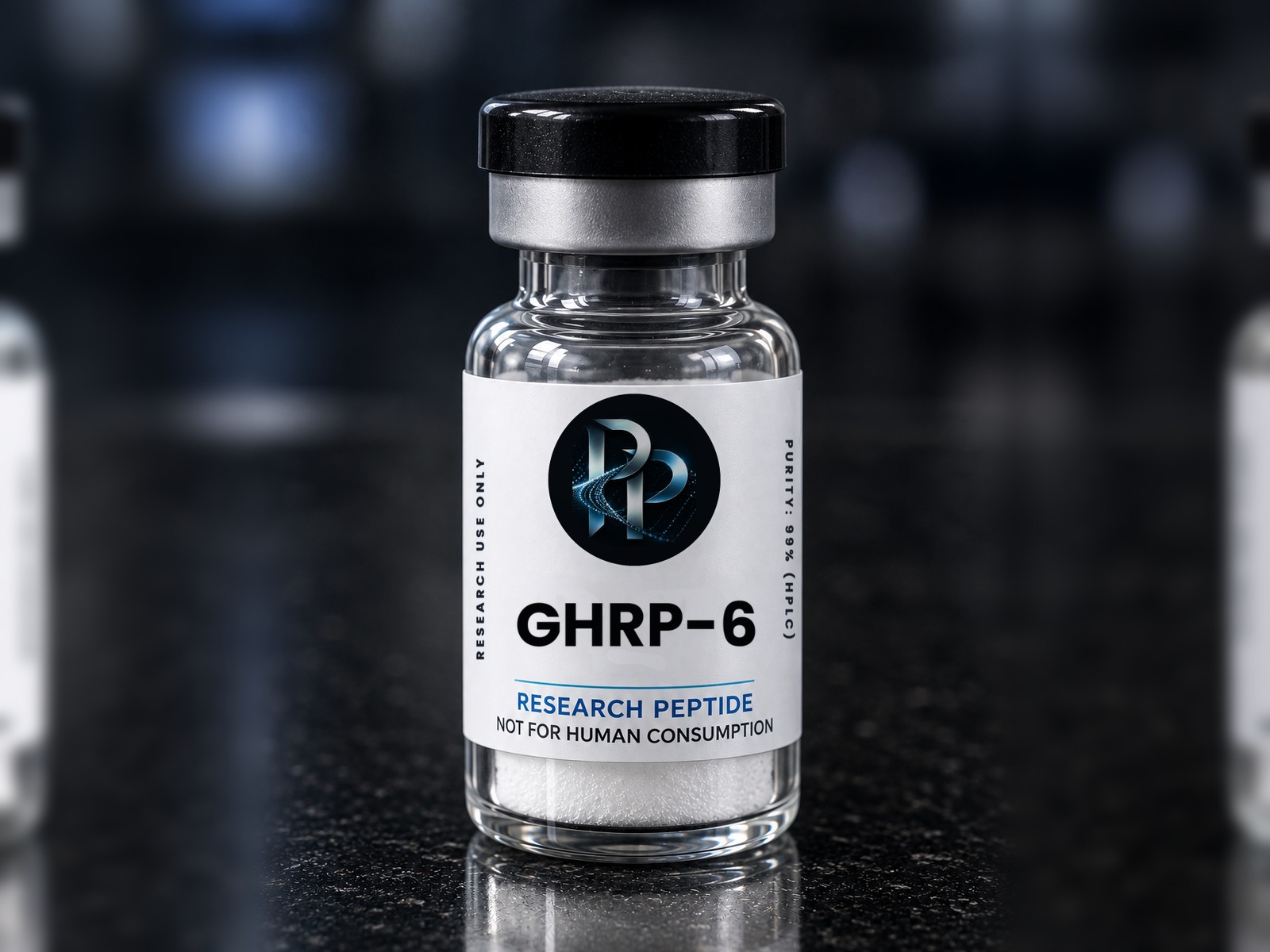
GHRP-6
Synthetic hexapeptide growth-hormone secretagogue
Also known as Growth hormone-releasing peptide 6, SKF-110679
One of the first synthetic growth-hormone-releasing peptides, developed from met-enkephalin analogues. Its discovery led to the identification of the ghrelin receptor.
Technical information
Values are shown with their status. “Verified” means the value has been checked against a primary database such as PubChem.
- Classification
- Synthetic hexapeptide growth-hormone secretagogue
- CAS number
- 87616-84-0 Pending
- Molecular formula
- C46H56N12O6 Pending
- Molecular weight
- 873.0 g/mol Pending
- Sequence / structure
- His-D-Trp-Ala-Trp-D-Phe-Lys-NH2 Pending
Some values are still being checked and should be treated as provisional until marked verified.
How this compound is tested
Hexapeptide with D-amino acids: LC-MS identity and HPLC purity are standard.
Research background
GHRP-6 was described by Bowers and colleagues in 1984 as a hexapeptide that released GH from the pituitary by a mechanism distinct from GHRH. The search for its receptor led to the cloning of the growth-hormone secretagogue receptor (GHS-R) in 1996 and subsequently to the discovery of ghrelin as the endogenous ligand. It remains a reference compound in secretagogue research.
Mechanisms investigated in published research
These are the mechanisms examined in the cited literature. Describing them is not a claim that the compound produces any effect in humans.
- GHS-R1a agonism on pituitary and hypothalamic cells.
- Also stimulates ACTH, cortisol and prolactin release and increases appetite in animal models — effects relevant to its lower selectivity compared with later secretagogues.
Summary of evidence
Laboratory and animal findings are kept separate from human clinical evidence.
Preclinical findings
1 citedExtensive rat, dog and primate GH-release pharmacology from the 1980s and 1990s; cardioprotection studies in rodent ischaemia models have also been reported.
Human clinical evidence
Early clinical pharmacology studies in the 1980s–90s characterised GH release in healthy volunteers and in GH-deficient subjects. GHRP-6 was never approved as a medicine.
Limitations and open questions
- Lower selectivity (ACTH, cortisol, prolactin, appetite effects) than later agents.
- Mostly historical data; few recent controlled studies.
- Prohibited in sport under the WADA list.
Scientific references
Publications cited on this page. Links open the publisher or PubMed record.
[1]Bowers CY, Momany FA, Reynolds GA, Hong A. On the in vitro and in vivo activity of a new synthetic hexapeptide that acts on the pituitary to specifically release growth hormone. Endocrinology (1984).
Preclinical Citation pendingOriginal description.
Research use only
GHRP-6 is described here for laboratory research. It is not approved for human or veterinary use unless a regulator has said otherwise, and nothing on this page is medical advice or guidance on administration. A disclaimer does not by itself make any activity lawful. Full disclaimer.
Contact options
Talk to the Positive Peptides team about GHRP-6
Order enquiries, documentation requests and technical questions about this compound — we answer directly, usually within two working days.
Related compounds
 Growth Hormone Axis Research99% purity
GHRP-2
Synthetic hexapeptide growth-hormone secretagogue
A second-generation GHRP with higher potency than GHRP-6. Approved in Japan as a diagnostic agent (pralmorelin) for growth-hormone deficiency.
 Growth Hormone Axis Research99% purity
Hexarelin
Synthetic hexapeptide growth-hormone secretagogue
A GHRP-6 analogue with a 2-methyl-tryptophan substitution, studied for GH release and, separately, for cardiac effects attributed to CD36 binding.
 Growth Hormone Axis Research99% purity
Ipamorelin
Pentapeptide growth-hormone secretagogue (ghrelin receptor agonist)
A synthetic pentapeptide agonist of the growth-hormone secretagogue receptor (GHS-R1a). Described in its original publication as selective for GH release with little effect on ACTH or cortisol.