
GHRP-2
Synthetic hexapeptide growth-hormone secretagogue
Also known as Pralmorelin, KP-102, Growth hormone-releasing peptide 2
A second-generation GHRP with higher potency than GHRP-6. Approved in Japan as a diagnostic agent (pralmorelin) for growth-hormone deficiency.
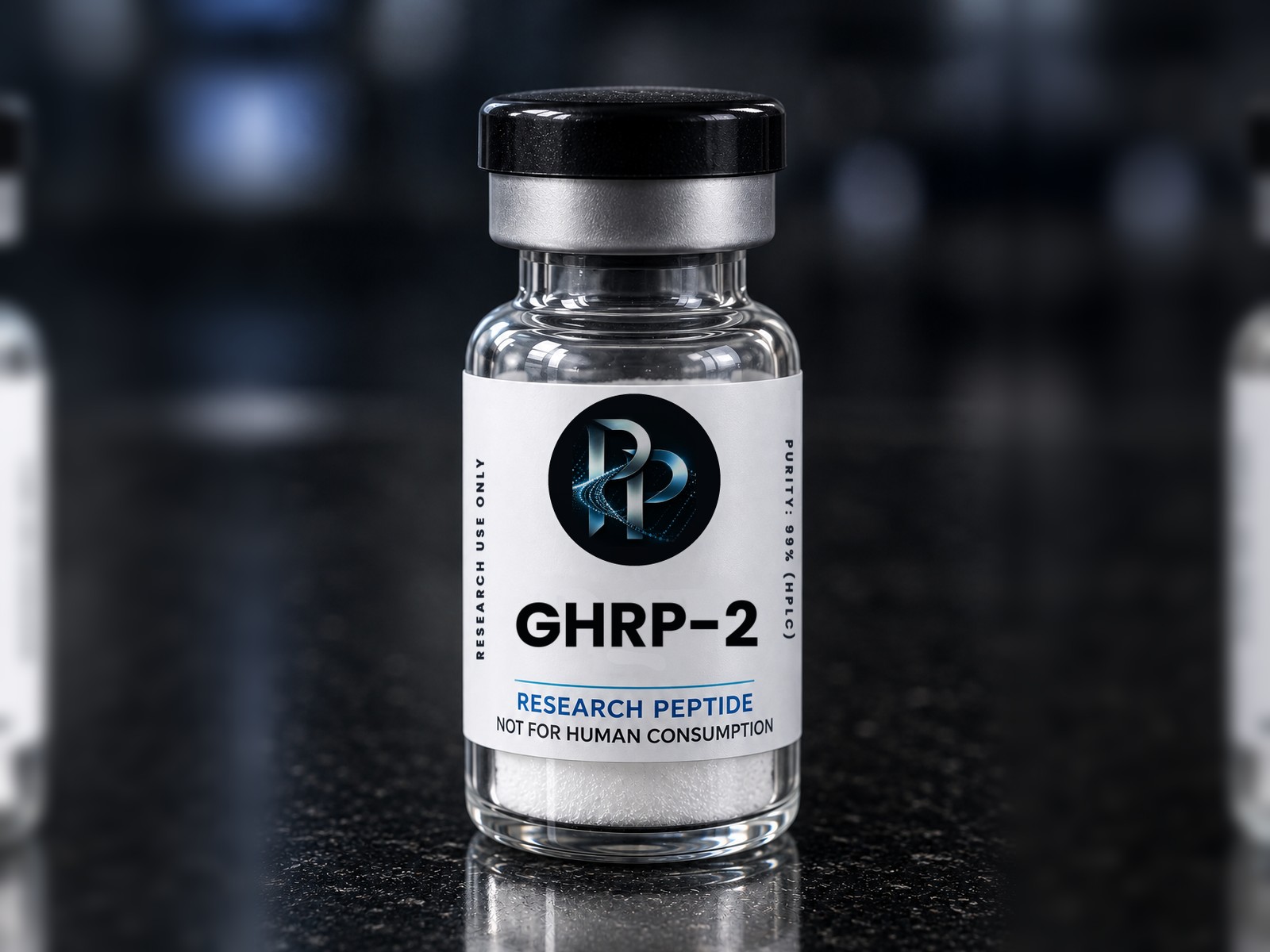
Technical information
Values are shown with their status. “Verified” means the value has been checked against a primary database such as PubChem.
- Classification
- Synthetic hexapeptide growth-hormone secretagogue
- CAS number
- 158861-67-7 Pending
- Molecular formula
- C45H55N9O6 Pending
- Molecular weight
- 818.0 g/mol Pending
- Sequence / structure
- D-Ala-D-2-Nal-Ala-Trp-D-Phe-Lys-NH2 Pending
Some values are still being checked and should be treated as provisional until marked verified.
How this compound is tested
LC-MS identity and HPLC purity; the non-natural D-2-Nal residue should be reflected in the mass.
Research background
GHRP-2 (pralmorelin) was developed as a more potent successor to GHRP-6. In Japan it is licensed as a diagnostic agent for GH deficiency under the name KP-102/GHRP Kaken. It is used in research as a potent GHS-R1a reference agonist.
Mechanisms investigated in published research
These are the mechanisms examined in the cited literature. Describing them is not a claim that the compound produces any effect in humans.
- GHS-R1a agonism, with potent GH release.
- Also increases ACTH/cortisol and prolactin, though to a lesser degree than GHRP-6 in some reports.
Summary of evidence
Laboratory and animal findings are kept separate from human clinical evidence.
Preclinical findings
Animal GH-release pharmacology and receptor-binding studies supporting its diagnostic development.
Human clinical evidence
1 citedClinical studies in Japan supported its approval as a diagnostic test agent for GH deficiency. It is not licensed as a therapeutic anywhere.
Limitations and open questions
- Diagnostic approval in one jurisdiction only; therapeutic use not established.
- Prohibited in sport under the WADA list.
Scientific references
Publications cited on this page. Links open the publisher or PubMed record.
[1]Chihara K, Shimatsu A, Hizuka N, et al.. A simple diagnostic test using GH-releasing peptide-2 in adult GH deficiency. European Journal of Endocrinology (2007).
Human clinical Citation pendingNo link publishedDiagnostic-use study in Japan. DOI/PMID to be added by an administrator after locating the record.
Research use only
GHRP-2 is described here for laboratory research. It is not approved for human or veterinary use unless a regulator has said otherwise, and nothing on this page is medical advice or guidance on administration. A disclaimer does not by itself make any activity lawful. Full disclaimer.
Contact options
Talk to the Positive Peptides team about GHRP-2
Order enquiries, documentation requests and technical questions about this compound — we answer directly, usually within two working days.
Related compounds
 Growth Hormone Axis Research99% purity
GHRP-6
Synthetic hexapeptide growth-hormone secretagogue
One of the first synthetic growth-hormone-releasing peptides, developed from met-enkephalin analogues. Its discovery led to the identification of the ghrelin receptor.
 Growth Hormone Axis Research99% purity
Hexarelin
Synthetic hexapeptide growth-hormone secretagogue
A GHRP-6 analogue with a 2-methyl-tryptophan substitution, studied for GH release and, separately, for cardiac effects attributed to CD36 binding.
 Growth Hormone Axis Research99% purity
Ipamorelin
Pentapeptide growth-hormone secretagogue (ghrelin receptor agonist)
A synthetic pentapeptide agonist of the growth-hormone secretagogue receptor (GHS-R1a). Described in its original publication as selective for GH release with little effect on ACTH or cortisol.