
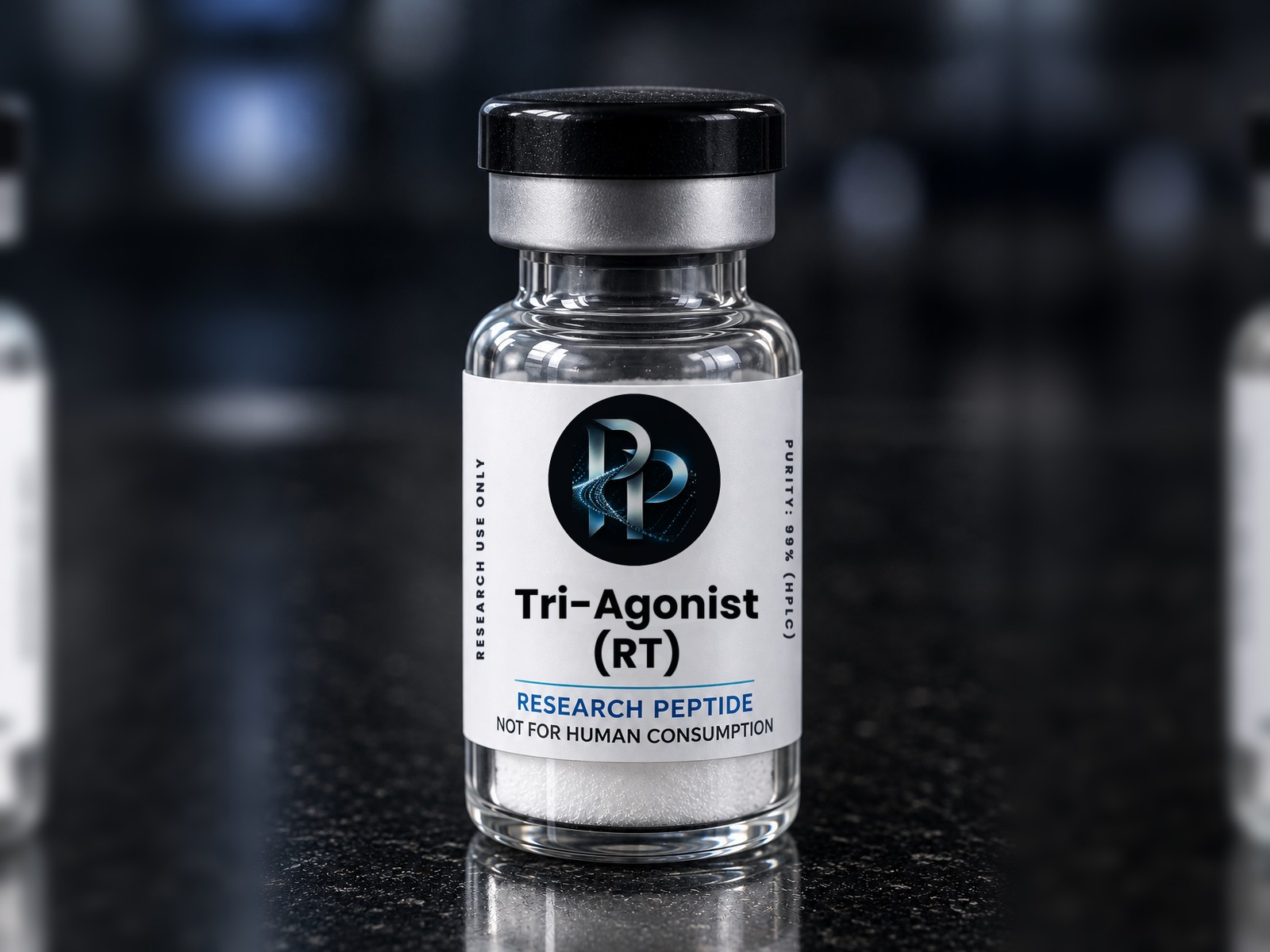
RT Tri-Agonist
Triple GIP/GLP-1/glucagon receptor agonist (investigational peptide)
Also known as GIP/GLP-1/glucagon triple agonist RT; development code LY3437943
An investigational single-molecule agonist of the GIP, GLP-1 and glucagon receptors, currently in late-stage clinical development. Not an approved medicine anywhere as of this profile.
Technical information
Values are shown with their status. “Verified” means the value has been checked against a primary database such as PubChem.
- Classification
- Triple GIP/GLP-1/glucagon receptor agonist (investigational peptide)
- CAS number
- 2381089-83-2 Pending
- Molecular formula
- C221H342N46O68 Pending
- Molecular weight
- 4731.3 g/mol Pending
- Sequence / structure
- 39-aa acylated peptide (see data source) Pending
Some values are still being checked and should be treated as provisional until marked verified.
How this compound is tested
As for other acylated multi-agonist peptides: LC-MS intact mass and HPLC purity. Reference standards for an investigational compound may be scarce; the COA should state what reference material, if any, was used.
Research background
RT Tri-Agonist extends the multi-agonist concept by adding glucagon receptor activity to GIP/GLP-1 agonism. Glucagon receptor agonism is of interest for its effects on hepatic lipid metabolism and energy expenditure in preclinical models. The compound is under development by Eli Lilly and is investigational; it has not completed regulatory review.
Mechanisms investigated in published research
These are the mechanisms examined in the cited literature. Describing them is not a claim that the compound produces any effect in humans.
- Triple agonism at GIP, GLP-1 and glucagon receptors, with activity balanced across the three in engineered assays.
- Investigation of hepatic fat, energy expenditure and glucose regulation in animal models and early human studies.
Summary of evidence
Laboratory and animal findings are kept separate from human clinical evidence.
Preclinical findings
Rodent studies during development reported body-weight and metabolic effects attributed to combined receptor activation.
Human clinical evidence
1 citedA phase 2 randomised trial in adults with obesity (Jastreboff et al., 2023; n = 338) reported dose-dependent changes in body weight over 48 weeks. Phase 3 trials are ongoing. Phase 2 data are preliminary and the product remains investigational; no regulatory approval exists.
Limitations and open questions
- Investigational status: safety and efficacy have not been established by regulators.
- Phase 2 sample sizes are small and durations short relative to phase 3.
- Research-grade material is not the clinical investigational product.
Scientific references
Publications cited on this page. Links open the publisher or PubMed record.
[1]Jastreboff AM, Kaplan LM, Frías JP, et al.. Triple-hormone-receptor agonist retatrutide for obesity — a phase 2 trial. New England Journal of Medicine (2023).
Human clinical Citation pendingPhase 2; investigational product.
Research use only
RT Tri-Agonist is described here for laboratory research. It is not approved for human or veterinary use unless a regulator has said otherwise, and nothing on this page is medical advice or guidance on administration. A disclaimer does not by itself make any activity lawful. Full disclaimer.
Contact options
Talk to the Positive Peptides team about RT Tri-Agonist
Order enquiries, documentation requests and technical questions about this compound — we answer directly, usually within two working days.
Related compounds
 Metabolic Research99% purity
Semaglutide
Acylated GLP-1 receptor agonist (31-amino-acid analogue)
A long-acting glucagon-like peptide-1 (GLP-1) receptor agonist. In its licensed pharmaceutical forms it is an approved medicine; as a research compound it is used to study incretin signalling, appetite regulation and glucose homeostasis.
 Metabolic Research99% purity
Tirzepatide
Dual GIP/GLP-1 receptor agonist (39-amino-acid acylated peptide)
A single-molecule dual agonist of the glucose-dependent insulinotropic polypeptide (GIP) and GLP-1 receptors. Licensed as a medicine in several jurisdictions; used in research to study multi-receptor incretin pharmacology.