
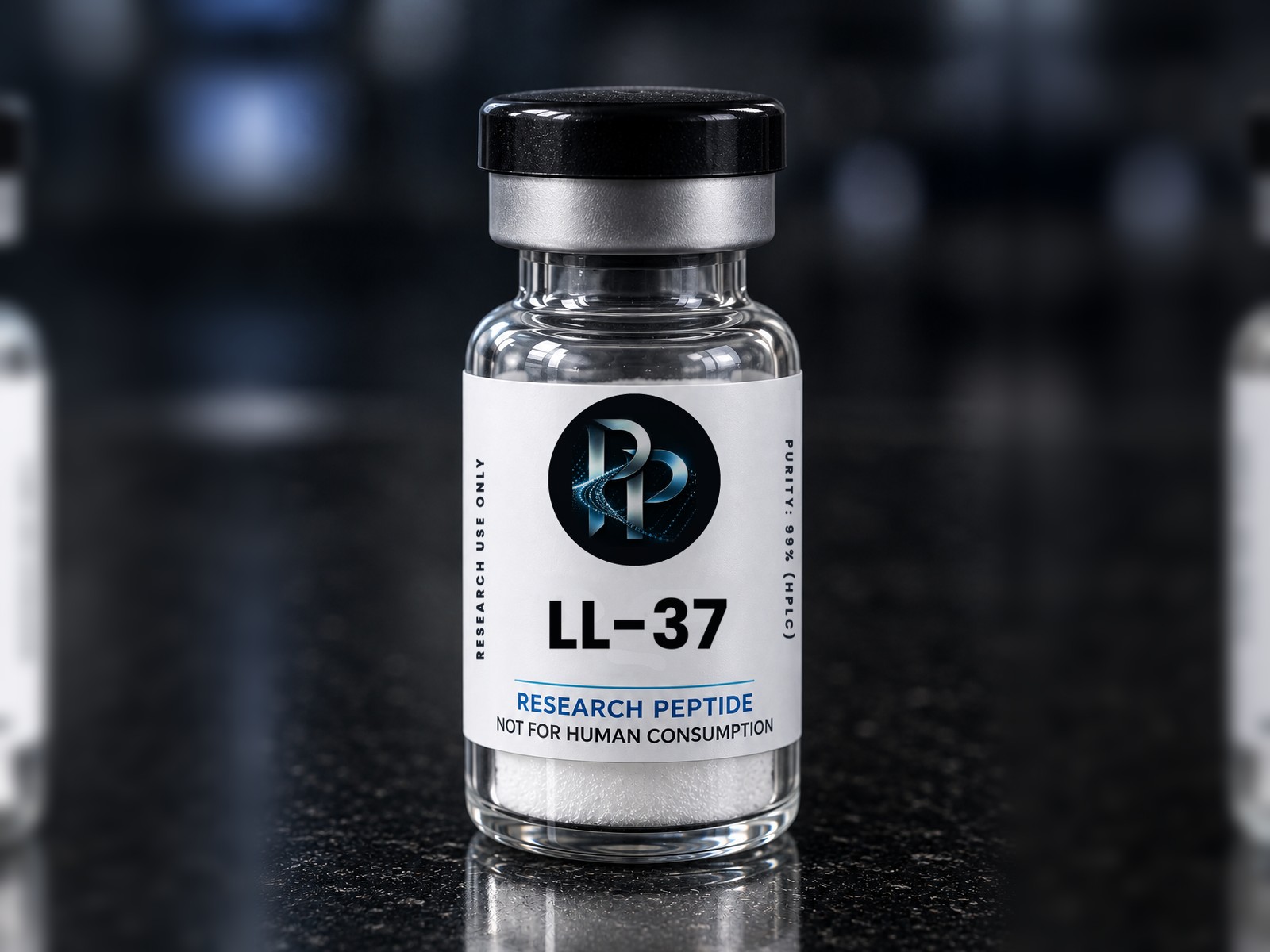
LL-37
Human cathelicidin-derived 37-amino-acid antimicrobial peptide
Also known as Cathelicidin antimicrobial peptide (CAMP) active fragment, hCAP18(134-170)
The only human cathelicidin, released from the precursor hCAP18. A model host-defence peptide with broad antimicrobial and immunomodulatory activity studied across microbiology and immunology.
Technical information
Values are shown with their status. “Verified” means the value has been checked against a primary database such as PubChem.
- Classification
- Human cathelicidin-derived 37-amino-acid antimicrobial peptide
- CAS number
- 154947-66-7 Pending
- Molecular formula
- C205H340N60O53 Pending
- Molecular weight
- 4493.3 g/mol Pending
- Sequence / structure
- LLGDFFRKSKEKIGKEFKRIVQRIKDFLRNLVPRTES Pending
Some values are still being checked and should be treated as provisional until marked verified.
How this compound is tested
LC-MS identity for the 37-residue peptide; HPLC purity. Researchers may also request endotoxin testing because LL-37 binds LPS, which complicates immunological experiments.
Research background
LL-37 is cleaved from hCAP18 by proteinase 3 in neutrophils and by other proteases in skin and mucosa. It is amphipathic and α-helical in membrane-mimicking environments, and it disrupts bacterial membranes. It also acts on host cells, modulating chemotaxis, cytokine release and wound responses. Its dysregulation is studied in conditions including psoriasis and rosacea (Dürr et al., 2006).
Mechanisms investigated in published research
These are the mechanisms examined in the cited literature. Describing them is not a claim that the compound produces any effect in humans.
- Membrane disruption of Gram-positive and Gram-negative bacteria via carpet/toroidal-pore models.
- Immunomodulation via formyl-peptide receptor-like 1 (FPR2), P2X7 and EGFR transactivation in host cells.
- LPS neutralisation in vitro.
Summary of evidence
Laboratory and animal findings are kept separate from human clinical evidence.
Preclinical findings
Extensive in-vitro antimicrobial data and rodent models of infection and wound healing; also studied in biofilm models.
Human clinical evidence
Investigational topical formulations have been studied in small early-phase wound-healing trials. No approved medicine.
Limitations and open questions
- Activity is highly salt- and serum-dependent; in-vitro MICs may not predict in-vivo performance.
- Cytotoxicity to host cells at higher concentrations.
- Synthetic LL-37 is expensive and aggregation-prone; purity and aggregation state matter analytically.
Scientific references
Publications cited on this page. Links open the publisher or PubMed record.
[1]Dürr UHN, Sudheendra US, Ramamoorthy A. LL-37, the only human member of the cathelicidin family of antimicrobial peptides. Biochimica et Biophysica Acta — Biomembranes (2006).
Review Citation pending
Research use only
LL-37 is described here for laboratory research. It is not approved for human or veterinary use unless a regulator has said otherwise, and nothing on this page is medical advice or guidance on administration. A disclaimer does not by itself make any activity lawful. Full disclaimer.
Contact options
Talk to the Positive Peptides team about LL-37
Order enquiries, documentation requests and technical questions about this compound — we answer directly, usually within two working days.
Related compounds
 Immune & Antimicrobial Research99% purity
KPV
C-terminal tripeptide fragment of α-melanocyte-stimulating hormone
The C-terminal tripeptide of α-MSH, studied for anti-inflammatory activity in intestinal epithelial and immune cell models.
 Immune & Antimicrobial Research99% purity
Thymosin Alpha-1
Naturally occurring 28-amino-acid acetylated peptide (synthetic form)
A thymic peptide studied for immunomodulatory activity. Its synthetic form, thymalfasin, is licensed in a number of countries (not the UK or US) as an adjunct in hepatitis B and other indications.